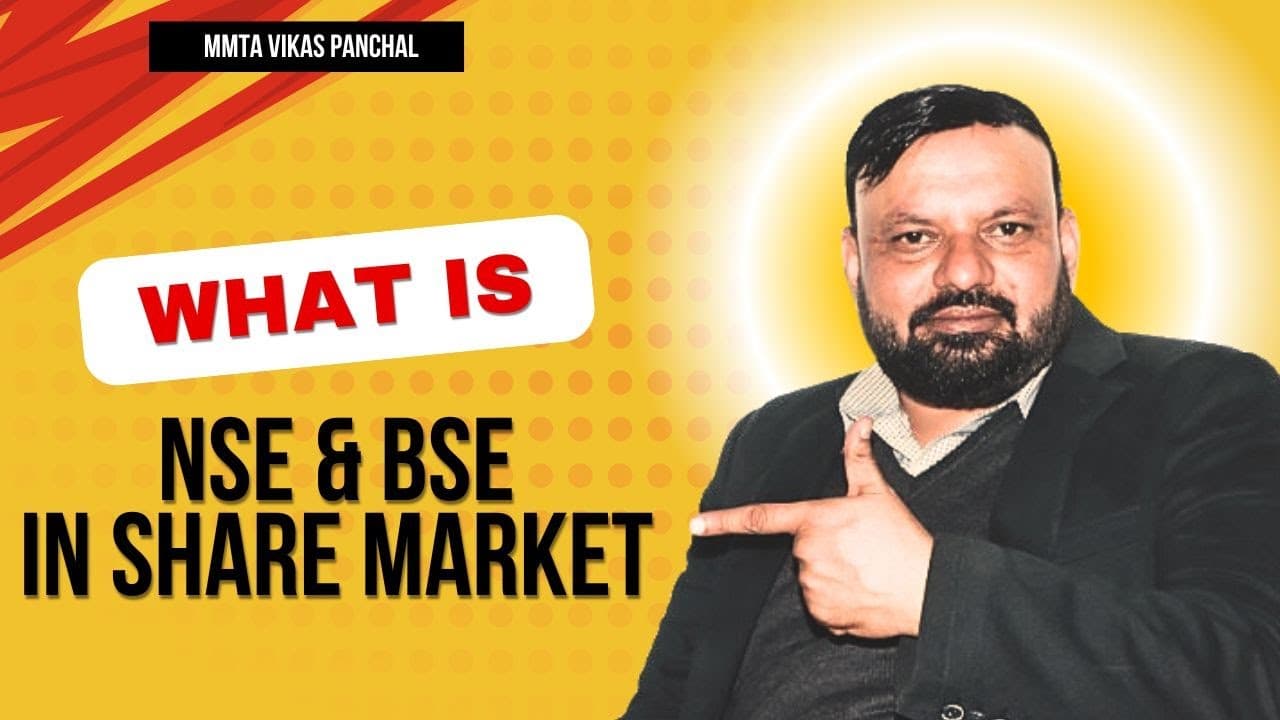
What is the share market? A plain-English guide for Indian beginners
A share is a portion of a company. The share market is where those portions change hands. Here is how it works, what you can trade in it, and why most people who trade actively lose money.
The share market is the place where ownership in listed companies is bought and sold. "Share" means hissa, a portion: when you buy a share of a company, you own a small slice of it and take a share of its profits and its losses. In India this buying and selling happens electronically on two exchanges, the NSE and the BSE, through a broker, under the supervision of SEBI.
That is the whole idea. Everything else, from Nifty to options to commodity lots, is built on top of it. This lesson walks through the parts a beginner needs, in the order Vikas Panchal explains them in the video.
What does "share" actually mean?
Vikas starts with the words themselves. Share means hissa (a portion). Market means bazaar. So share market means a bazaar where portions of companies are traded.
He explains it with a property example. Suppose you want to buy a property worth Rs 1,000, but you only have Rs 500. You can bring in a partner for the other Rs 500. That partner now owns 50 percent of the property. If the property earns rent, they get half. If it loses value, they lose half.
Now suppose the partner does not have the full Rs 500 either. They bring in their own partner for 30 percent of their share. The ownership keeps getting divided into smaller pieces. Each piece is a share.
A listed company is the same thing at a much larger scale. Instead of two or three partners, there are lakhs of shareholders, each holding a small number of shares. If you buy 100 shares of SBI, you own a tiny fraction of the bank, and you take part in its profits and losses in proportion to those 100 shares.
How does a company end up in the share market?
A company that wants money to grow can borrow from a bank, or it can sell pieces of itself to the public. The first time it sells shares to the public is called an IPO, an initial public offering. After the IPO, the shares are "listed" on an exchange, and from that day anyone with a trading account can buy or sell them.
Two points matter here for a beginner.
First, when you buy shares on the exchange, you are usually buying from another investor, not from the company. The company got its money at the IPO. After that, shares change hands between the public.
Second, the company does not promise to give your money back. A share is ownership, not a loan. Its value goes up and down with what people are willing to pay for it.
Where does the buying and selling happen?
In the video, Vikas describes how the market used to work. Before it was computerised, brokers, called dalals in Hindi, gathered in one place and called out prices: this company's shares, at this rate, who wants them? Buyers and sellers were matched by voice.
That system is gone. Today the exchanges run electronic order books. You place an order on your broker's app, the broker sends it to the exchange, and the exchange matches it with the best available opposite order in a fraction of a second.
You need three things to take part:
- A demat account, which holds your shares in electronic form, the way a bank account holds money.
- A trading account with a SEBI-registered broker, which places your orders on the exchange.
- A bank account linked to both, for moving money in and out.
The two exchanges are the NSE (National Stock Exchange) and the BSE (Bombay Stock Exchange). Most large companies are listed on both. The difference between NSE and BSE is covered in its own lesson.
What can you trade in the share market?
Vikas makes a point that confuses many beginners. People say "main share market mein trade karta hoon", meaning "I trade in the share market", but the share market has several parts, and you should know which part you are in.
- Equity: shares of companies. This is what most people mean by the share market.
- Indices: Nifty 50 and Sensex are baskets of large companies. You cannot buy an index directly, but you can trade it through derivatives or hold it through index funds.
- Commodities: gold, silver, crude oil and others, traded as futures contracts on commodity exchanges.
- Currency: exchange-rate contracts such as USD/INR. For Indian residents, only INR-pair currency derivatives on Indian exchanges (NSE, BSE, MCX-SX) are legal. Overseas forex brokers and margin forex trading routed through LRS are not permitted by the RBI.
- Derivatives: futures and options, which are contracts based on the price of a share, index or commodity rather than the thing itself.
Vikas compares it to going to a bazaar. You do not buy from every shop. You pick the shops you understand. The share market has many parts, and you should pick one and learn it properly before touching the others.
Why do share prices move?
A share's price is simply the last price at which a buyer and a seller agreed. If more people want to buy than sell, the price rises. If more want to sell, it falls.
What makes people want to buy or sell changes from minute to minute: company results, interest rates, news, global markets, and often plain mood. Over years, a company's profits matter most. Over a single day, sentiment and order flow matter more. This gap is exactly why investing and trading are treated as two different activities.
A worked example in rupees
Suppose SBI is trading at Rs 500 and you buy 100 shares. You pay Rs 50,000, plus brokerage and exchange charges, which vary by broker.
- If the price rises to Rs 520, your 100 shares are worth Rs 52,000, a gain of Rs 2,000 before costs.
- If the price falls to Rs 480, they are worth Rs 48,000, a loss of Rs 2,000.
- If SBI declares a dividend of, say, Rs 10 per share, you receive Rs 1,000 in your bank account, because you are a part-owner.
Nothing is locked in until you sell. A gain on paper can become a loss the next week, and the other way round. This is the "profit aur loss ke hissedar" idea from the video: you take part in both.
Why do some people make money and others lose?
Vikas ends the video on the question beginners ask most. His answer is short: the difference is how they traded, not luck.
It is worth being direct about this. Most people who trade actively in the share market lose money. SEBI has published its own studies of individual traders in derivatives, and the large majority of those traders ended the year with a loss. The reasons repeat: trading on tips, using borrowed money, no plan for exits, and no patience to learn first.
Buying shares of sound companies and holding them for years is a different activity with different risks, but it is not risk-free either. The reasons most people lose money are covered in a separate lesson, and they are worth reading before you place a single order.
If you want a structured starting point, META's free course, Trading for Everybody, covers these basics in Hindi with the same examples. META is an education provider, not a SEBI-registered investment adviser, and nothing here is a recommendation to buy or sell anything.
Common mistakes
- Treating the share market as one thing. Equity, options and commodities behave differently and need different knowledge.
- Buying because a WhatsApp or Telegram group said so. You are the one who carries the loss.
- Confusing a share with a fixed deposit. A share has no guaranteed return and no maturity date.
- Starting with options or intraday because the amounts look small. The risk is not small.
- Ignoring costs. Brokerage, STT and other charges reduce every gain and add to every loss.
Key takeaways
- A share is a portion of ownership in a company. Owners share profits and losses.
- Buying and selling happens electronically on the NSE and BSE through a SEBI-registered broker, with shares held in a demat account.
- Equity, indices, commodities, currency and derivatives are all parts of the share market. Learn one part at a time.
- Prices move on supply and demand, driven by results, news and sentiment.
- Most active traders lose money. Education, patience and your own analysis are the only things in your control.
Questions people ask
This lesson is for education only and is not investment advice. Trading involves risk of loss and most people who trade lose money. META is not a SEBI-registered investment adviser. Read our disclaimer.