Half knowledge is dangerous: why 'kaam chalau' trading fails
A 'kaam chalau' trader knows just enough to place a trade and not enough to survive one. Five rules from the video, and an honest answer to how long learning takes.
Half knowledge is dangerous in trading because it lets you place a trade without a plan for your money, your loss or your exit. A "kaam chalau" trader (someone who knows just enough to get by) copies what others do, often with borrowed money, and has no fixed loss limit. Learning enough to be dangerous takes a week. Learning enough to survive takes months of study and practice, and there is no shortcut around that.
What a "kaam chalau" trader looks like
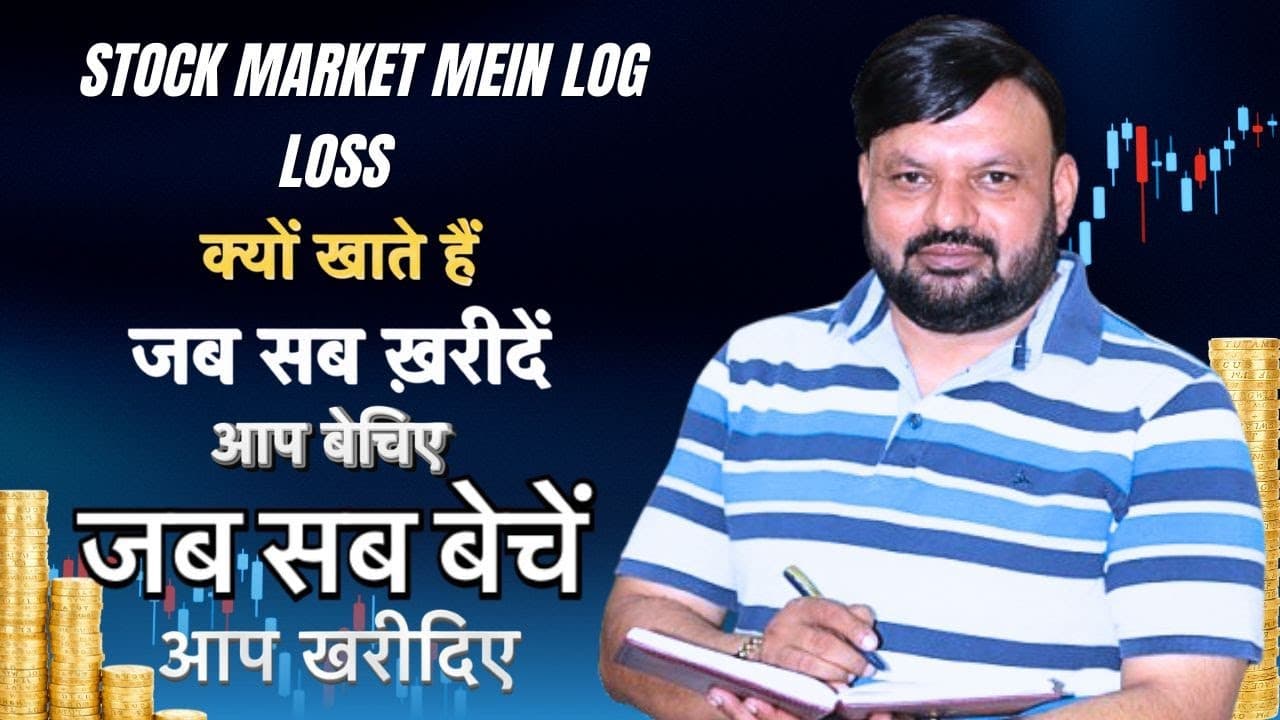
In the video, Vikas addresses anyone who wants to become a trader with one warning: do not become a kaam chalau trader. The phrase means "good enough to get the work done", and in trading that is not good enough at all.
The kaam chalau trader has watched a few videos, knows what a candlestick is, and has seen someone else post a profit screenshot. That is the whole basis for the trade. He does not know where his entry should be, where his loss should be booked, or how much of his money he can afford to lose. He knows enough to press buy and not enough to know when to press sell.
Vikas calls the alternative a tukka trader, someone trading on tukka (a guess). Both fail for the same reason: the trade has no structure around it. The rest of the video is his structure, in five rules.
The money rules: surplus only, never borrowed
Rule 1: trade only with surplus money
His first rule is that the money you trade with must be surplus money. He defines it carefully: money that is genuinely extra, sitting apart from your household needs, savings goals and emergencies. Money you earned from a profit elsewhere, money you can lose 2 or 5 percent of without it changing anything at home.
The reason is not sentimental. Money you cannot afford to lose changes how you trade. You hold losers too long because you cannot face the loss. You exit winners too early because you need the money to be real. The market does not know that this is your rent, but your hands do.
Rule 2: never trade with borrowed money
The second rule is stricter: never put loan money, credit card money or money borrowed on interest into the market. Vikas makes an interesting point here. People call the share market a jua (gamble). He says the market is not a gamble; we make it one. And the fastest way to make it one is to borrow at 12 or 18 percent interest, put it in because "woh to profit nikaal raha hai" (he is taking profit, so I can too), and then need the market to pay you back on a deadline.
A borrowed rupee has a clock on it. A trade with a clock on it is not a trade, it is a bet with a due date. If the trade goes wrong, you now have a loss and a loan.
Decide your loss before your profit
The third rule is the one most beginners get backwards. Vikas says to carry your loss with you from day one: decide, before you trade, how much percent loss you can book, and book it when it comes.
Experienced traders, he says, set a rule for themselves at the start. Something like: I will look for 10 to 15 percent on a trade and I will accept 5 to 10 percent against me. The actual numbers depend on the instrument and the style, and we cover how to set them in risk reward ratio explained. What matters is that the loss number exists before the profit number does.
His phrasing is worth remembering: this is a market for making big money from small money, but it is not a market for taking a big loss for a small profit. A trader who will risk Rs 20,000 to make Rs 2,000 has the equation upside down.
A worked example
Suppose you have Rs 2,00,000 that is genuinely surplus. You decide your maximum loss on any single trade is 1 percent of that, or Rs 2,000, following the one percent rule.
You are watching SBI. It is trading at Rs 800 and you want to buy at Rs 790 if it comes there, with a stop-loss at Rs 770. Your risk per share is Rs 20. So your position is Rs 2,000 divided by Rs 20, which is 100 shares, costing Rs 79,000.
If the stop is hit, you lose Rs 2,000 plus charges. That is 1 percent of your capital. You can be wrong like this many times in a row and still be in the game. Compare that with the kaam chalau version: buying 250 shares at Rs 810 because a group said "SBI rocket", with no stop, and watching it fall to Rs 740. That is a Rs 17,500 loss, nearly 9 percent of capital, on one trade.
Neither trade is guaranteed to work. The first one is survivable. The second one is not, if you repeat it.
Confidence and patience, not tukka
The fourth rule is about the mind. Once you have taken a trade with your own analysis, Vikas says, do not sit there second-guessing it every minute: "kahin loss na ho jaye, kahin neeche na chali jaye" (what if it loses, what if it falls). Either you had a reason for the trade or you did not.
He is careful to tie confidence to preparation. Confidence here does not mean stubbornness. It means you did the work, you know your entry, your stop and your target, so you do not need to ask anyone else what to do mid-trade. The two things he says a trader needs are confidence and patience. Patience to wait for your level, and confidence to act on it without a second opinion.
The failure he describes is very common. A person takes a trade on someone's say-so, then cuts it on someone else's say-so, right before it would have worked. Then they say "kaash main ruk jaata" (I wish I had stayed). They were never in control of the trade at any point.
One trade at a time
The fifth rule is simple. Vikas compares it to a shopkeeper: he opens his shop in the morning and closes it at night. Finish one trade, book its profit or its loss, and only then take the next one. Do not have four open positions you are managing on fear. Beginners who stack trades are usually not diversifying, they are overtrading.
How long does it take to learn trading?
People search "trading seekhne me kitna time lagta hai" hoping for a number of days. There is no honest number, but there is an honest shape.
The mechanics, meaning how to place an order, what a lot is, what margin means, take a couple of weeks. Understanding one instrument well enough to know its normal range and how it behaves at its highs and lows takes a few months of daily watching, as Vikas says in most of his videos. Having a written plan with entry, stop and size, and following it for fifty or more trades so you can see whether it works, takes longer still.
Most people who say they learned trading in a month learned the mechanics and then paid the market for the rest. A structured path, like the one in how to learn share market from zero, does not make it faster, it makes it cheaper. Remember that most people who trade lose money, and the ones who last are usually the ones who spent longest learning before they sized up.
Common mistakes
- Trading with money that has a job at home. The moment it is needed elsewhere, you stop trading the chart and start trading your fear.
- Borrowing to trade because someone else is profitable. Their knowledge is not transferable by loan.
- Setting a target and no stop. The stop is the number that keeps you in business.
- Cutting a good trade because a stranger in a group panicked. If you did not take the trade on their view, do not exit on it either.
- Opening a second trade to make up for the first. Close the shop before you open another one.
- Believing a week of watching videos is knowledge. It is vocabulary. Knowledge is fifty trades with a journal.
Key takeaways
- A kaam chalau trader knows how to enter and not how to exit. That gap is where the money goes.
- Trade only with surplus money, and never with loans or interest-bearing funds.
- Fix your maximum loss per trade before you think about profit, and book it when it comes.
- Confidence comes from preparation, not from conviction. Patience is waiting for your own level.
- One trade at a time. Book it, learn from it, then take the next.
- There is no fixed timeline for learning. Expect months, not days, and expect to lose small while you learn.
Questions people ask
This lesson is for education only and is not investment advice. Trading involves risk of loss and most people who trade lose money. META is not a SEBI-registered investment adviser. Read our disclaimer.